You’ve probably heard someone say a tattoo just “fades with age” like it’s some unavoidable law of physics. It’s not, really. Time plays a small part, sure, but the actual villain behind most dull, blurry, prematurely aged tattoos is sitting up in the sky doing its thing every single day. UV exposure is the number one reason tattoos lose their crispness, and summer is prime season for it to do damage you won’t even notice until it’s already done.
What UV Actually Does to Ink
Tattoo ink sits in the dermis, the layer of skin just below the surface, held in place by cells called fibroblasts. UV rays penetrate deep enough to break down those ink particles and scatter pigment molecules, which is why sun-damaged tattoos do not just look lighter, they look muddy and soft-edged, like someone smudged a photo. Black ink tends to go gray. Reds and yellows fade the fastest because those pigments are more photosensitive. Blues and greens hang on a little longer, but nothing is actually immune.
This is not a fresh-tattoo problem exclusively either. People assume once a tattoo is fully healed, usually around four to six weeks out, it is in the clear. It is not. A five-year-old tattoo left unprotected on a beach trip is absolutely still vulnerable. Sun damage is cumulative, and it does not discriminate by tattoo age.
The SPF Habit Nobody Talks About
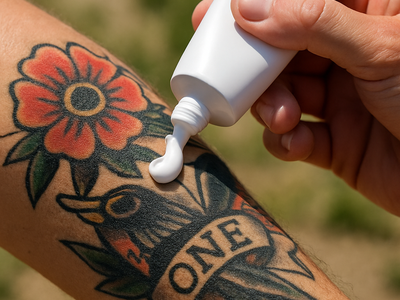
Everyone knows sunscreen matters for skin health in general, but tattoo-specific sun care rarely gets the airtime it deserves. The advice is genuinely simple: once your tattoo is fully healed, treat it like the most sun-sensitive part of your body, because functionally it kind of is.
- Use a broad-spectrum SPF 30 or higher, reapplied every couple of hours if you are outside for extended periods.
- Mineral sunscreens (zinc oxide or titanium dioxide) tend to sit better on tattooed skin and are less likely to cause irritation than some chemical formulas.
- Cover it when you can. A lightweight long-sleeve shirt or a hat brim over a chest or shoulder piece does more than any lotion ever will.
- Reapply after swimming or sweating, not just once in the morning and forgotten about.
If you want something specifically formulated with tattoos in mind, a product like tattoo-specific sunscreen is worth keeping in your bag all summer, especially if you have larger color pieces you are proud of. It is a small habit that pays off over years, not days.
Why This Matters More for Certain Tattoos
Fine line and single-needle tattoos are especially vulnerable to sun fading because there is less ink density to begin with. A thin, delicate line has way less pigment to lose before it starts looking patchy or disappears into the skin entirely. If you have got a minimalist piece you paid good money for, sun protection is not optional, it is basically maintenance. Bold traditional work with heavy black outlines has more of a buffer, but more of a buffer is not the same as bulletproof.
Color-heavy realism pieces are their own category of concern too. All that shading and blending relies on subtle pigment transitions, and once the sun starts breaking those down unevenly, the whole piece can start looking flat and two-dimensional instead of dimensional. Dermatologists who study skin aging, including resources from the American Academy of Dermatology, point out that UV damage compounds over years, which is exactly the timeline most people keep a tattoo for.
The Real Fix Is Boring
There is no clever trick here. Sunscreen, shade, and covering up when it is brutal outside. It is not glamorous advice, but it is the difference between a tattoo that still looks sharp at year ten and one that looks like it has been left out in a window for a decade, because in a sense, it has. If you want to double-check your piece is healing or aging the way it should, a dermatologist or your original artist can usually tell at a glance whether what you are seeing is normal settling or actual sun damage.
Basically, sunscreen is not just a skin cancer conversation anymore. It is tattoo preservation. Keep some in your bag through August, not just for your face.