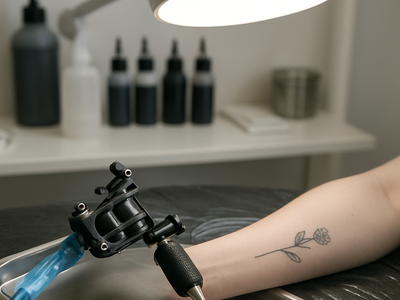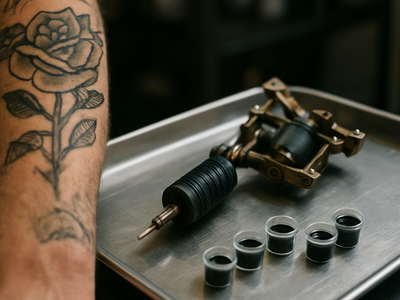
You’re six months out from a fresh piece, healing’s long done, and suddenly you notice a line that used to be crisp now looks like it’s been smudged with a wet thumb. That’s a blowout, and it’s one of those things nobody warns you about until it’s already happened to your ankle tattoo or your forearm script.
What’s Actually Happening Under Your Skin
Tattoo ink is supposed to sit in the dermis, the layer just below your epidermis. It’s dense enough to hold pigment in place for decades. A blowout happens when ink gets pushed too deep, into the looser, fattier layer beneath the dermis, or injected at too steep an angle. Once it’s down there, the ink has nowhere stable to sit, so it spreads sideways under the skin like spilled ink soaking into a paper towel. The result is a soft, blurry halo around a line that was probably razor-sharp on day one.
It’s not the same thing as normal fading. Fading happens evenly, over years, from sun and time. A blowout shows up early, usually within the first few weeks to months, and it’s localized. One line looks fuzzy while everything around it stays sharp.
Why It Happens
Mostly it comes down to technique. Needle angle that’s too steep, too much pressure, or going over the same line repeatedly can force ink past the dermis. Certain spots on the body make it more likely too: places where the skin is thin, loose, or flexes constantly, like fingers, inner wrists, elbows, and ankles. That’s part of why hand and finger tattoos have a rough reputation for not holding up. Thin skin gives the needle less room for error.
Sometimes it’s not the artist’s fault at all. Skin that’s naturally thin, over-moisturized right before the session, or still swollen from a numbing cream can behave unpredictably under the needle, which is one more reason numbing products aren’t the shortcut people think they are.
Can You Tell the Difference Between a Blowout and Just Bad Healing?
Give it the full 4 to 6 weeks before panicking. Some blurriness during the peeling and settling phase is completely normal. A true blowout doesn’t resolve after healing finishes. It stays put, and it usually has a distinct grayish or bluish tint under the surrounding skin, almost like a bruise that never left.
What You Can Actually Do About It
Once ink is under the dermis, it’s not coming back up. There’s no cream, no massage technique, no amount of exfoliating that reverses it. Your realistic options are:
- Live with it. Minor blowouts on bold, thick linework are sometimes barely noticeable once the piece is fully healed and settled.
- Cover or rework it. A skilled artist can sometimes incorporate the blurred area into a redesign, using shading or a thicker line to visually absorb the spread.
- Laser it out. For blowouts that bother you enough, a few rounds of laser tattoo removal on just that section can fade it before a touch-up or cover-up.
None of these are quick fixes, which is annoying, but it’s the reality of ink sitting in the wrong layer of skin.
How to Avoid One in the First Place
This is really about picking the right artist for the right spot. If you’re getting something on your fingers, wrist, or ankle, look specifically for artists who’ve done a lot of work in that exact placement, not just a strong general portfolio. Fine line and delicate placements need a lighter, more controlled hand than a big back piece does. It’s worth asking directly, \”have you done a lot of finger or ankle work?\” before you sit down. The American Academy of Dermatology also has solid guidance on aftercare basics that reduce irritation and swelling, which indirectly lowers your risk too, since inflamed, over-swollen skin is harder to tattoo cleanly.
During healing, keep the area calm. A gentle, fragrance-free balm like Hustle Butter Deluxe helps keep skin from getting too dry or angry while it settles, which matters more for thin-skin placements where any extra irritation can make existing blowout-prone areas look worse before they look better.
Blowouts aren’t a sign you did something wrong as a client. They’re mostly a placement-and-technique issue, which is exactly why the research you do before booking matters more for a finger tattoo than it does for a big, bold piece on your thigh.