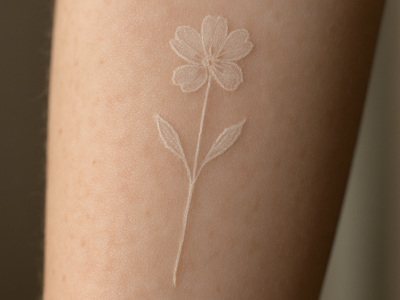
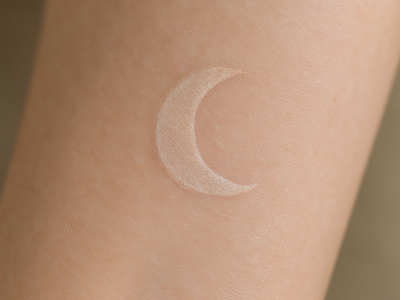
Every few months white ink tattoos go viral again. Someone posts a delicate little crescent moon or a barely-there flower on their wrist, the lighting is perfect, and thousands of people save the photo to their “tattoo ideas” folder. Then a year later that same person posts an update, and the tattoo looks like a faint yellowish scar. This isn’t bad luck. It’s just how white ink behaves.
The Pigment Problem
White tattoo ink is titanium dioxide based, and it’s a much bulkier, less stable pigment than the carbon-based blacks and grays used in traditional linework. It doesn’t sit in the skin the same way. Instead of settling into a crisp, dense line, white ink tends to spread and diffuse under the surface, which is part of why it looks so soft and glowy in photos taken right after the appointment. That softness isn’t the ink settling in nicely. It’s the ink already starting to blur.
Your body also treats white ink as more of a foreign substance to clear out than black ink, so it fades faster and less predictably. Some spots hold on, some go patchy, and the result after a couple of years is rarely the clean, ethereal design you saw on your artist’s portfolio wall.
Skin Tone Changes Everything
White ink shows up completely differently depending on the person wearing it, and almost nobody talks about this before booking the appointment. On fair skin, fresh white ink can look bright and stark, almost like a scar. On medium to deep skin tones, it often reads as a faint shimmer rather than a distinct design, which some people love and others find disappointing once they realize the tattoo is nearly invisible from a normal viewing distance. And summer makes this worse for everyone: a tan darkens the surrounding skin while doing nothing for the ink underneath, so the contrast that made the tattoo visible in April can disappear by August.
Healing Is Deceptively Rough
White ink tattoos scab and heal like any other tattoo, but because there’s no dark pigment to distract the eye, every bit of redness, irritation, or uneven healing is way more visible during the process. It’s common for people to panic mid-healing because the tattoo looks blotchy or inflamed, when a black tattoo in the same spot would just look normal and settled. The healing itself isn’t more painful or complicated. It’s just more exposed, cosmetically speaking, while it’s happening.
So Is It Ever a Good Idea?
Not never. Some artists use white ink well as an accent, layered thinly over or alongside black work to add highlights, texture, or a subtle glow effect, similar to how a painter uses white paint to add dimension rather than as the entire piece. Used this way, some fading and softening over time doesn’t ruin the tattoo because it was never meant to be the star of the show.
Where it tends to go wrong is when white ink is the entire tattoo: a standalone symbol, word, or design with no black outline or shading to anchor it. Those pieces rely on ink behaving in a way it just doesn’t reliably do long term.
What to Ask Before You Book One
- Ask your artist how many all-white pieces they’ve done and if they have healed photos from a year or more out, not just fresh work.
- Consider whether a very thin black outline could give the design some staying power without changing the look you want.
- Be honest with yourself about whether you’re drawn to the design or drawn to how it looks in a single, perfectly lit photo.
White ink isn’t a scam and it isn’t inherently bad work. It’s just a pigment with real limitations that Instagram doesn’t show you. Go in knowing that, and you’ll either avoid a disappointing fade or end up genuinely fine with it, which is a much better place to be a year from now.